
Greek Villages in Italy?
Grecìa Salentina is an area of Puglia, Italy featuring a unique group of towns southeast of Lecce where an ancient Greek dialect called Griko is still spoken. It represents the “Greek soul” in southern Italy. This Greek influence is characterized by whitewashed architecture, Byzantine influences, and traditions like the Taranta music festival.
Griko Language
A mix of ancient Greek, Byzantine, and Latin, this endangered language is still used by older generations and taught in schools.
Scholars debate whether Griko descends directly from the 8th-century BCE colonies of Magna Graecia or from later medieval Byzantine migrations. It preserves archaic features like Ancient Greek infinitives and vocabulary that has disappeared from Standard Modern Greek.
Unlike standard Greek, Griko is most commonly written using the Latin alphabet.
tThere are two primary dialect varieties:
Griko: Spoken in the Grecìa Salentina area of Apulia.
Greko (or Grecanico): Spoken in the Bovesia region of Calabria
.
Cultural Heritage
The Salento area is known for its “Greek-Byzantine” churches, such as St. Stefano(Soleto) and St. Caterina (Galatina)-
Santa Caterina Basilica, “Assisi of the South” has frescoes with the naturalism of the Giotto style, sharing the same mastery of color and human narrative pioneered by Giotto
This area is also famous for the Notte della Taranta music festival.

Origins
The area is believed to be settled by Greek populations in antiquity, maintaining a strong connection to Magna Graecia
Byzantine Persistence
Following the Roman era, many parts of southern Italy, including Puglia, remained under Byzantine control until the 11th century, reinforcing Greek language, religion, and customs.
Atmosphere
These ancient towns offer a glimpse into authentic, slow-paced Southern Italian life, featuring historic centers, underground oil mills, and ancient megalithic monuments like dolmens and menhirs.
What are Dolmens and Menhirs?
In Southern Italy—particularly in the regions of Puglia and Sardinia—the landscape is dotted with mysterious stone structures dating back to the Neolithic and Bronze Ages. These megaliths are the silent echoes of prehistoric communities.
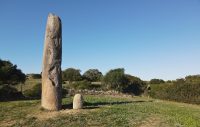 A Menhir is a single standing stone planted vertically in the ground. The word comes from Middle Breton (men = stone, hir = long). In Southern Italy, specifically in the Salento region of Puglia, they are often called Pietrafitte. They range from simple, rough-hewn pillars to tapered stones reaching several meters high. Theories suggest they served as boundary markers, astronomical calendars, or phallic symbols representing fertility and the connection between earth and sky. Interestingly, many Italian menhirs were “Christianized” during the Middle Ages; you’ll often find crosses carved into them or small niches for icons
A Dolmen is a megalithic tomb typically consisting of two or more vertical “orthostats” (upright stones) supporting a large flat horizontal “capstone.” The name translates to “stone table.”
In local Italian folklore, they are sometimes called Tavole dei Paladini (Tables of the Knights). They look like stone portals or small chambers. Originally, many were covered with earth or smaller stones to create a mound (tumulus), though most of that earth has eroded away over millennia. They were primarily collective burial chambers. Excavations often reveal human remains along with grave goods like pottery and tools. The Dolmen la Chianca in Bisceglie (Puglia) is one of the best-preserved and most famous examples in Europe.
Are the Dolmens, Menhirs and the Griko culture intertwined?
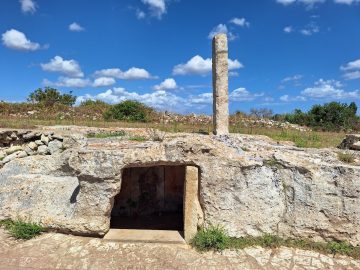
Not really. The Dolmens and Menhirs existed almost 3000 years before the Griko culture, but interestingly they almost perfectly align gegraphically with the Griko cities.
The Grecia Salentina (the “Greek Salento”)—the cluster of villages where Griko culture and language still survive—is exactly where Puglia’s highest concentration of megaliths is found. Towns like Calimera, Martano, and Zollino are Griko cultural hubs, but they are also home to famous prehistoric stones like the Menhir of Teofilo.
Griko: The Last Greeks of Italy
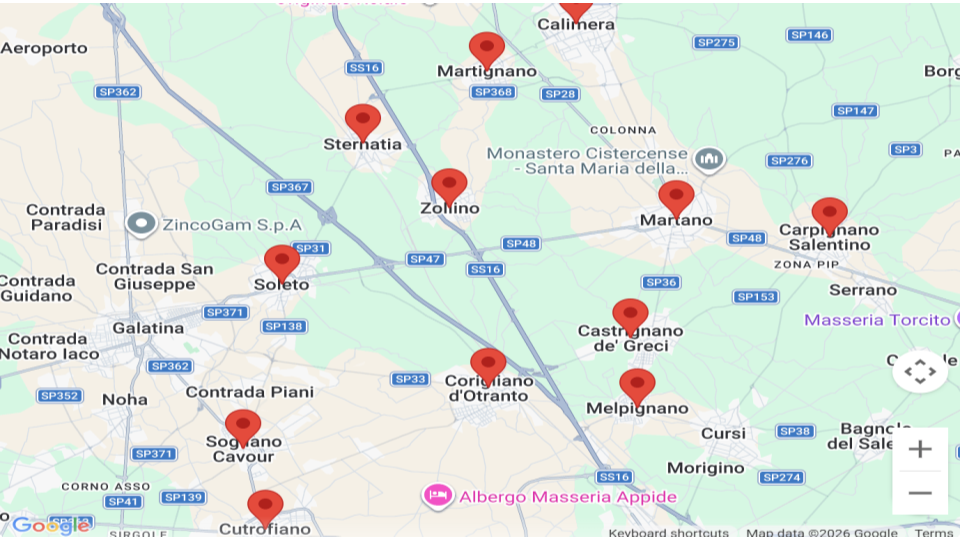
The 12 Municipalities of Grecìa Salentina (2026)
There are many Salento towns that have many Griko or Byzantine elements, and likely part of the Greek-speaking area during the Middle Ages, but lost the language much earlier than the “Gricìa” towns. Giurdignano, for example, shares the same prehistoric landscape and “Megalithic garden” atmosphere as the Griko heartland, but it differs in its linguistic and political history. By the time linguistic surveys were conducted in the 19th and 20th centuries, Giurdignano had fully transitioned to the Salentino dialect (a Romance/Latin-based language), whereas towns like Martano or Calimera kept Griko alive.

Calimera
Its name means “good morning” in Greek. Calimera is uniquely characterized by its 3,000 year-old Greek heritage, which is integrated into its name, language, and sacred rituals. The town’s public gardens house an ancient Attic burial stone (4th century BCE) donated by Athens in 1960. It bears the inscription: “Zeni su en ise ettù sti Kalimera,” meaning “You are not a stranger here in”. The House-Museum of Griko Culture is located in a traditional courtyard house, this museum preserves artifacts of peasant life and a library of 3,000 publications dedicated to the anthropological and linguistic roots of the Griko people. Calimera is a central hub for the revitalization of the endangered Griko dialect, maintaining strong cultural and emotional ties to Greece through specialized tours and educational efforts.
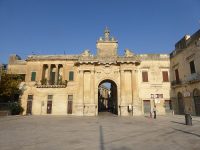
Carpignano Salentino
Castrignano dei Greci
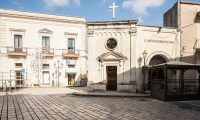
Known as the “Castle of the Greeks”, Castrignano dei Greci is a treasury for the preservation of the Griko dialect of Salento. The town is a leading center for “active teaching” and recovery of the Griko language to ensure its 3,000-year-old roots are not lost.
Originally a medieval fortress, Castello Baronale (De’ Gualtieris) was transformed into a noble residence in the 16th century. It is well-preserved and offers a panoramic view of the surrounding countryside. As you walk through the historic center, you will encounter narrow streets and small communal courtyards known in Greek as àvili, a structural legacy of the ancient civilizations that inhabited the village.
Corigliano d’Otranto
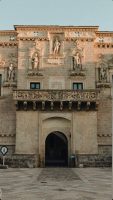
Home to the impressive Castello de’ Monti, this 16th-century fortress is the town’s symbolic landmark. It is renowned for its dual nature: a rugged medieval defensive structure with four massive circular towers and a moat, later “softened” with an ornate Baroque façade featuring allegorical statues and a richly decorated cantilevered balcony. In the Giardino di Sophia, a garden adjacent to the castle, visitors can take a guided walk through ancient virtues and engage with intellectual themes.
Check out the inscriptions on the beautiful ancient buildings around the town, lintels, arches and churches- you will find Italian, Latin and Griko. The surrounding countryside is dotted with prehistoric dolmens and menhirs, proving that the area has been a spiritual and communal hub since the Bronze Age.

Cutrofiano
The town’s name reflects its heritage, deriving from the Greek word kutra (vase). In local dialect, typical clay containers are still called cutrubbi. Cutrofiano is widely recognized as the Ceramic Capitol of Salento. Visitors can still walk through the town to see active botteghe (workshops) where master potters use techniques passed down since the Middle Ages
Also check out the Crypt of San Giovanni. Located about 1km from the town center, this rock-cut (hypogeum) church features Byzantine fresco fragments and dates back to early medieval times.
Martano
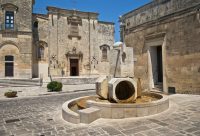
Martano is the primary hub for the preservation of Griko, a Neo-Greek dialect. You can still hear residents speaking it, and almost every old family is known by a specific Griko name that defines their traditional talents.
Since 2017, Martano has been officially recognized for its large-scale cultivation and transformation of Aloe vera by local companies.
Martignano
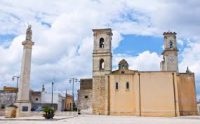
Martignano is the smallest of the Griko municipalities , vibrant town in the heart of the Grecìa Salentina, a unique linguistic and cultural enclave in Puglia. It is primarily special for being one of the few places where the ancient Griko language—a Greek dialect dating back to antiquity or the Byzantine era—is still spoken and celebrated.
Carnevale di Martignano is a major event in February/March that combines traditional Martignanese carnival customs with the wider heritage of the Grecìa Salentina, featuring elaborate floats and costumed groups.
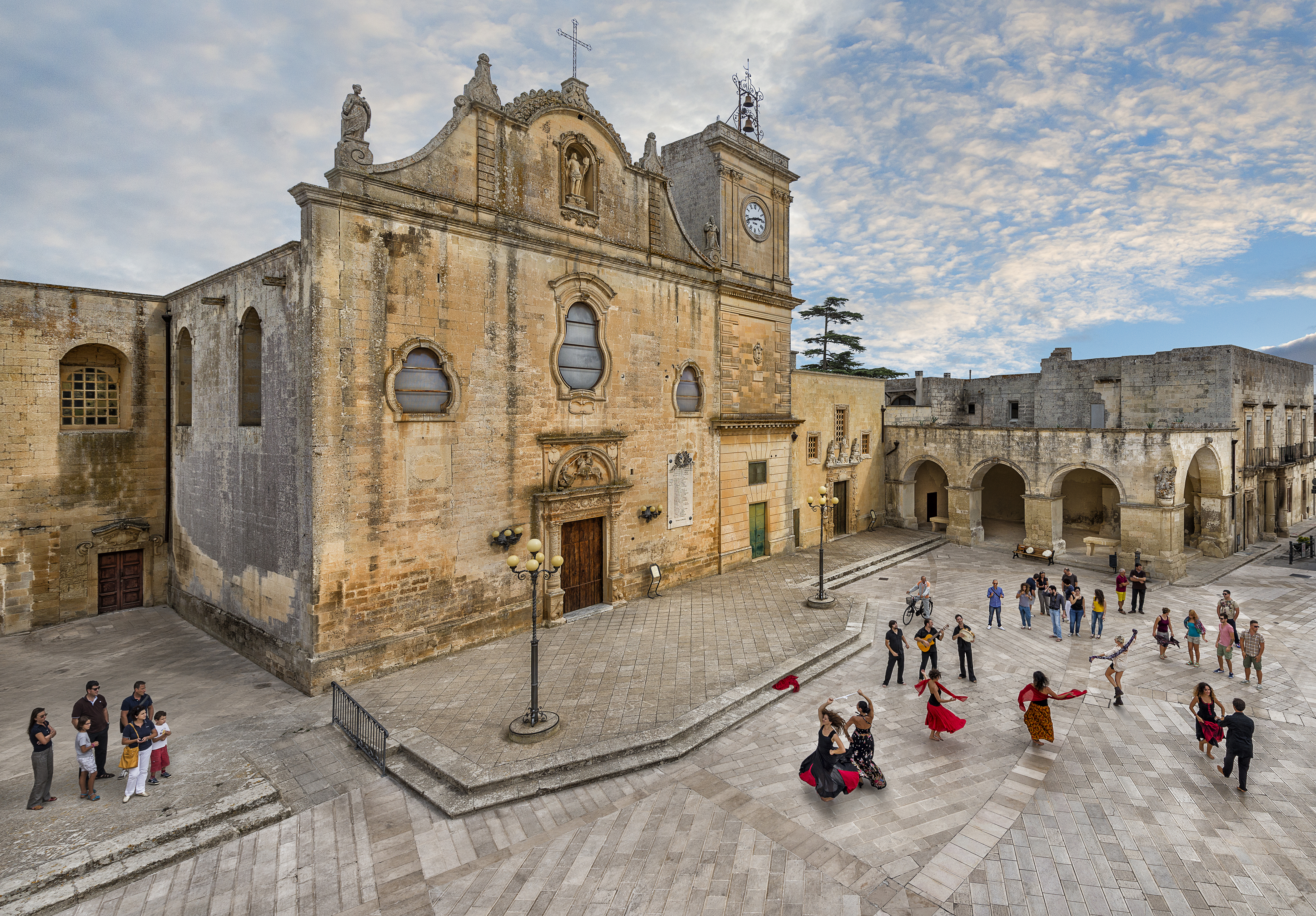
Melpignano is one of the most culturally significant towns in the Grecìa Salentina, connecting Hellenic traditions and modern Mediterranean culture. While it is a quiet, characteristic village for most of the year, it transforms into the folk music capital of Southern Italy every August.
Melpignano is world-famous for hosting the finale of the Notte della Taranta, one of the largest folk music festivals in Europe. The event celebrates the Pizzica, a traditional dance and music style once used as a ritual to “cure” the bite of a tarantula. The final concert takes place in the massive open space in front of the Ex Convento degli Agostiniani, drawing hundreds of thousands of visitors to see international artists collaborate with local musicians
The town’s layout and monuments are exceptional examples of Salentine Baroque and communal living history. Ex Convento degli Agostiniani is the town’s most iconic landmark, a former Augustinian convent with a magnificent Baroque facade.

Sogliano Cavour
Sogliano Cavour is a historic village in the heart of Salento that is special for its deep layers of history, ranging from prehistoric megaliths to its unique “Griko” roots. Despite its small size, it offers an authentic atmosphere of a traditional Salentine town, characterized by religious devotion and a landscape shaped by both man and nature.
The town’s history is a blend of different eras, famously associated with the legend of the Sun god and Janus Bifrons, which still influences the town’s symbols today. The area was heavily influenced by Basilian monks who arrived from the East, leaving behind a legacy of monastic caves and crypts. It also features an imposing Palace as a centerpiece of the town, reflecting the era of feudal lords and architectural transitions through the centuries. The town celebrates its patron saint, San Lorenzo, on August 10th, which is a major event featuring local traditions and summer festivities.
Soleto
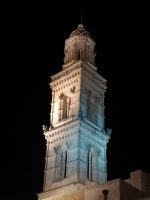
Soleto is a captivating town in the heart of the Grecìa Salentina, distinguished by a unique blend of medieval Gothic architecture, Byzantine art, and mysterious local legends. It sits strategically equidistant between the Ionian and Adriatic seas, a position that historically made it a vital cultural crossroads. The Centro Storico (Old Town) is a maze of narrow, winding alleys paved in pale limestone, filled with noble palaces and historic wells that reflect the town’s medieval and Baroque elegance. The Chiesa di Santo Stefano is a small, modest-looking 14th-century church that houses an extraordinary cycle of frescoes inside. Soleto’s dual heritage is highlighted with rare depictions of both a Byzantine and a Catholic priest side-by-side.
The 45-meter-high late Gothic tower was built in the late 14th century, commissioned by nobleman Raimondello Orsini. The tower is celebrated for its intricate carvings and imposing presence. Local folklore claims the alchemist Matteo Tafuri (known as the “Socrates of Soleto”) summoned a coven of witches and demons to build the entire tower in a single night. Legend says that as the sun rose, the demons were turned to stone; four monstrous stone figures are still visible today at the corners of the tower’s third level.
NOTE: Raimondello Orsini is the nobleman who commissioned this honorary tower AND the man that secretly bit off the fingerbone of Santa Caterina of Alessandria- and brought the relic back to Galatina for the founding of the Basilica.

Sternatia
Sternatia celebrates the Pittula Festival in December, pittule—deep-fried dough balls can be served savory with salt cod or sweet with honey, and the Festival of Salento Flavors in July, a three-night event features traditional dishes like plammi (olive bread) and souvlaki (skewers) alongside local folk music.
Zollino
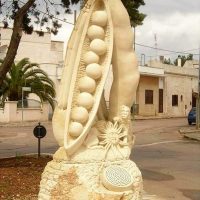
Be sure to taste “Nano di Zollino” (Zollino Dwarf Pea) – a specific variety of local broad bean, which are celebrated for their flavor and nutritional properties. Visitors often seek out local trattorias to taste dishes made with these unique legumes, which are a point of intense local pride.